
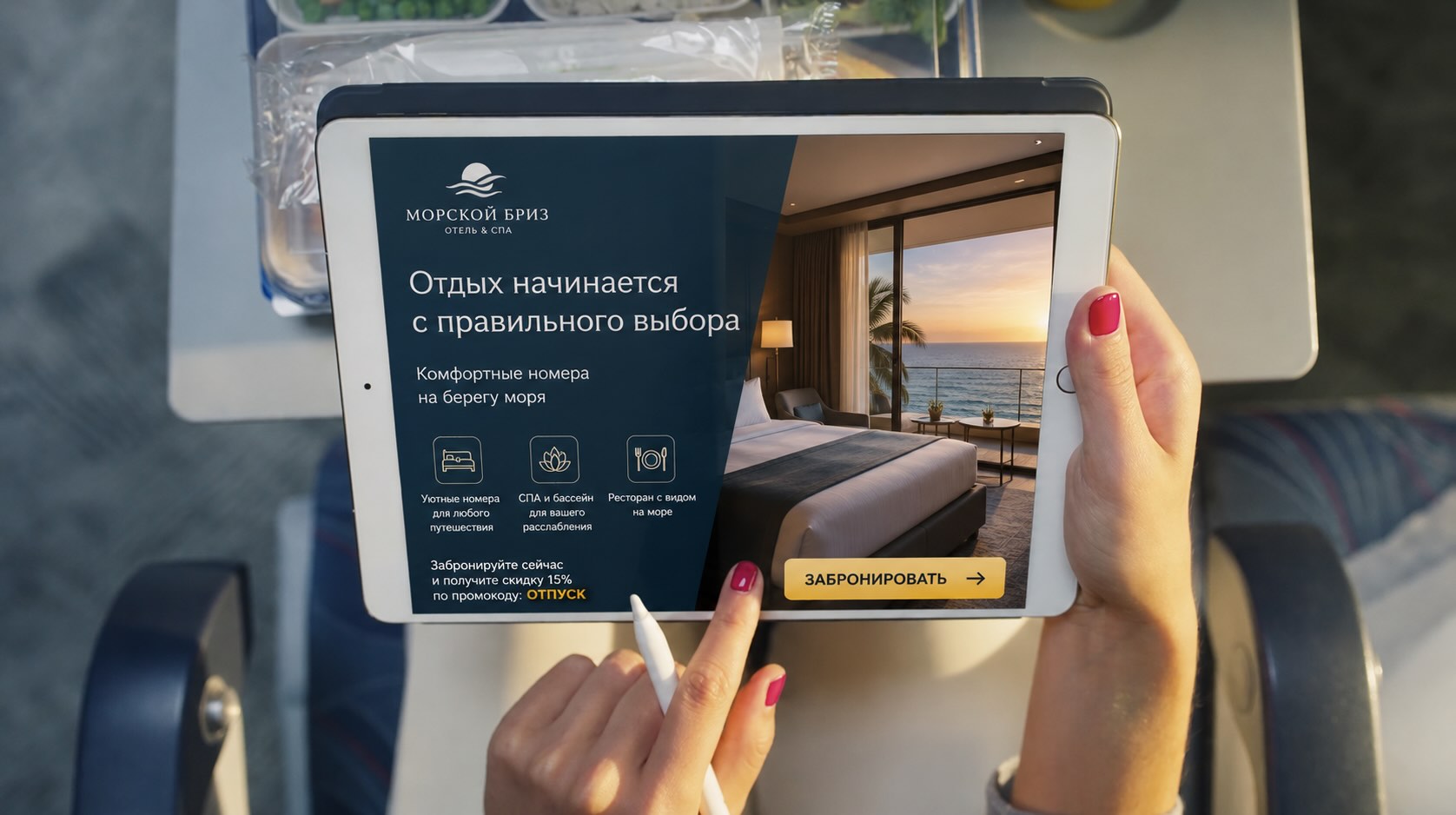
Advertising on airplanes has long remained a niche form of promotion, but interest in it is growing as in-flight entertainment systems and wireless access to media content continue to develop. For airlines, it is an additional source of revenue; for advertisers, it is an opportunity to reach passengers in an environment where their attention is focused differently than on the ground.
During a flight, passengers are in a confined space and typically spend enough time there that an on-screen message is more than just a fleeting glimpse. Passengers are less distracted by the urban environment, daily tasks, and the usual stream of notifications. Therefore, a video on the seatback screen or on a personal device may be viewed with greater attention than many forms of conventional online advertising.
That said, it would be an exaggeration to consider an airplane an environment where attention is fully guaranteed. Passengers may be sleeping, reading, working, listening to music, or not using the in-flight entertainment system at all. However, in-flight advertising does have one distinct feature: if a person turns on the screen and begins watching the content, the likelihood of meaningful engagement with the advertising message becomes higher than in an environment where an ad can be instantly scrolled past or closed.
This is most evident in short video clips that play before a movie, TV show, or other content on the in-flight entertainment system. Such messages are typically viewed at a leisurely pace, without competition from multiple open tabs, social media feeds, or external noise. Therefore, the first few seconds of the video are particularly important: it must be immediately clear to the viewer who is addressing them, what is being offered, and why it is relevant to their current situation.
Unlike mass advertising on the streets or online, in-flight advertising is more heavily influenced by the circumstances of the trip. A person might be flying on vacation, a business trip, to study, to visit family, or to a business meeting. If the message takes into account the flight’s destination, the season, and the possible purpose of the trip, it feels less abstract. For example, on flights to tourist destinations, offers related to hotels, insurance, transportation, or leisure services are more appropriate. On business routes, financial, educational, and business services are perceived as more logical.
In-flight advertising can be displayed not only on screens. Airlines and their partners use in-flight magazines, headrests, tray table inserts, cups, and other cabin elements. Together, these elements create several sequential points of contact with the passenger during a single flight. However, this approach requires caution: an excess of advertising materials in a limited space can backfire and be perceived as intrusive.
Simplicity and clarity are particularly important for in-flight videos. Standard online ads are not always suitable for in-flight viewing without adaptation. Small screens, varying image quality, audio characteristics, and flight duration call for a more understated approach. Short videos with a single main idea, large graphics, and a clear message work best. Complex editing, small text, long introductions, and overly detailed explanations reduce the effectiveness of this type of advertising.
It is also insufficient to evaluate the results of in-flight advertising based solely on immediate clicks or inquiries. For this type of advertising, brand memorability, message recognition, subsequent growth in inquiries, and follow-up engagement with passengers after landing are more important. A person may see a video on the plane and return to the offer later—whether through a search, on a website, in an app, or via another ad.
This promotional method is primarily suited for companies that don’t need an immediate response, but rather a gradual introduction to their offer. These may include banks, insurance companies, educational initiatives, healthcare providers, travel services, automotive brands, and other sectors where decisions aren’t made immediately and largely depend on trust.
Advertising on airplanes is not a one-size-fits-all solution and does not replace other promotional methods. Its potential is limited by the coverage of specific flights, placement costs, airlines’ technical requirements, and passenger behavior. However, with carefully selected routes, a subtle message, and a clear connection to the travel experience, it can become a valuable part of an overall advertising strategy.
The key feature of this type of advertising lies not in grandiose promises of near-guaranteed viewership, but in a different environment for consuming information. On an airplane, passengers have fewer external distractions and more time, which means an ad has a chance not only to be displayed but also to be noticed.