
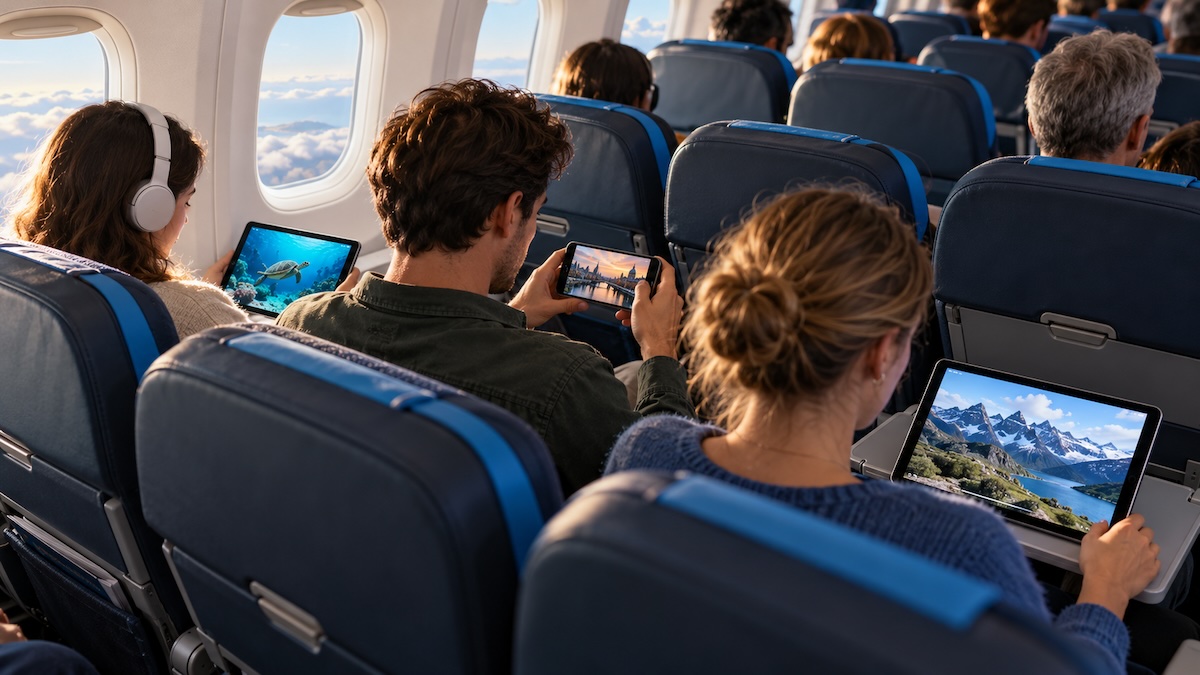
An evening flight, a full cabin. Passengers take out their smartphones and tablets: some continue a TV series, some choose a feature film, while nearby, parents put on a cartoon for their child. Each has their own screen, their own preferences, and their own start time. Behind this familiar scene is the onboard media server PAK "Etbox," developed by "Oblako" company. One device supports up to 200 simultaneous connections to Wi-Fly.
The onboard system is designed for an environment where many people use entertainment at the same time. After reaching cruising altitude, interest in the portal can grow throughout the entire cabin. Some passengers are just opening the catalog, others are already watching videos, and still others are switching between sections. Wi-Fly supports this general rhythm, maintaining a quick interface response and smooth content playback.
Movies, music, and other materials are stored on the server directly on the aircraft. Data is transmitted to passengers' personal devices via a local Wi-Fi network. There's no need to access a remote service or wait for external internet: everything needed for entertainment is already onboard. This organization ensures stable access to the media library throughout the flight.
Viewing remains individual. Passengers choose different films, start them at a convenient time, pause them, and return to favorite episodes. Activity on neighboring screens remains part of the system's operation, which the user doesn't have to think about. They simply open the material they're interested in and continue watching.
For large aircraft, multiple devices can be installed. The number of media servers is selected based on the cabin size and the number of users. This allows Wi-Fly to be scaled for a specific aircraft and maintain the usual service quality with a greater number of connections. Aircraft capacity becomes a system configuration parameter even during its implementation phase.
The same infrastructure provides access to onboard services and promotional materials. While some passengers watch movies, others can browse product catalogs, explore partner offers, or access branded content. Different scenarios coexist within a single portal, maintaining convenience for every user.
For the passenger, the technical operation of Wi-Fly remains behind the scenes. The catalog opens quickly on the screen, the film plays without loading interruptions, and switching to another section doesn't require waiting. It is from such details that comfort in flight is built — when the chosen entertainment is available the moment you want to use it.