
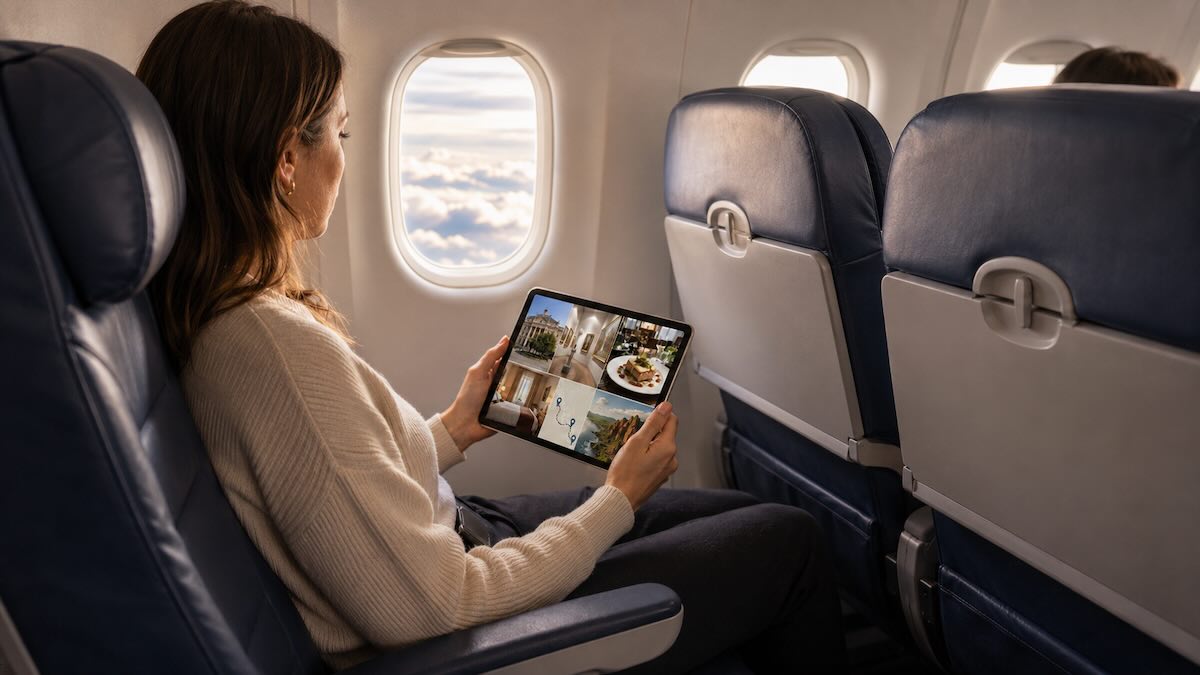
The plane hasn't even begun its descent, but the passenger is already deciding where to have dinner, which museum to visit, and how to get to their hotel. Usually, search engines, travel apps, and recommendations from acquaintances compete to answer these questions. However, the first digital window into the city can be an in-flight portal, accessible from a smartphone, tablet, or laptop directly during the flight.
For regional businesses, this is a rare opportunity to reach a person before their attention is divided among dozens of offers at the destination. The passenger has already chosen their destination, has time, and is interested in information about the place they are heading to. In such a situation, advertising can work not as a random message, but as a continuation of the journey.
The Wi-Fly platform combines entertainment content, an interactive map, flight information, commerce, and service ordering. The portal operates within the in-flight Wi-Fi network, so passengers do not need to install a separate application. In this environment, regional companies can promote their services using welcome and graphic banners, pop-up messages, pre-roll video ads, and small thematic microsites.
For a museum, such a microsite can become a digital billboard: presenting the main exhibition of the season, showcasing several exhibits, providing opening hours, and offering a discount with a promo code. Instead of a general call to "visit the museum," the passenger receives a specific reason to include it in their itinerary. If the offer is related to the flight route, it becomes especially relevant: it makes more sense to talk about an exhibition in Vladivostok to those who are actually flying to Vladivostok.
A restaurant can use the same channel differently. Passengers on a morning flight will be offered breakfast or an early lunch, while those arriving in the evening will be offered dinner, delivery, or a table reservation. The message can emphasize local cuisine, proximity to the hotel or airport, and a special offer for arriving tourists. A short banner introduces the establishment, and a microsite helps to show the menu, interior, and promotion details more thoroughly.
For hotels, the in-flight portal becomes a point of contact for those who have not yet decided on accommodation or are looking for additional services. In addition to a room, the hotel can offer a transfer, early check-in, breakfast, an excursion, or a weekend package. Even if accommodation is already booked, the passenger might be interested in the hotel's restaurant, spa, meeting room, or late check-out.
Tourist attractions get the opportunity to promote not only a single sight but also a ready-made travel itinerary. A countryside complex can offer a one-day route, an excursion company – a walk after check-in, and a nature park – a program for the family for the weekend. The clearer the offer is formulated, the fewer actions the passenger has to take after landing.
The relevance of advertising to the destination is particularly important. A federal campaign aims to reach as many people as possible, while for regional businesses, accuracy is more crucial: showing an offer to passengers on a specific flight or route. In such a model, a small company competes not with the size of its advertising budget, but with the relevance of its message.
The in-flight format also allows for evaluating audience reaction. The platform records impressions, views, and interactions with advertising materials, and clicks to the microsite help to understand which offer interested passengers. An additional indicator can be the use of a promo code after arrival. This way, a museum will see not only the number of page opens but also the number of visitors who came thanks to the campaign, and a restaurant or hotel can link their placement to bookings.
However, mere presence on board does not guarantee results. A passenger is unlikely to want an overloaded advertising catalog with many identical offers. The message should take into account the destination, arrival time, and possible travel scenario. One clear reason to visit a place works more convincingly than a long list of benefits.
The in-flight portal is gradually transforming from a media library into a digital showcase for the region. For the passenger, it's a way to get oriented in an unfamiliar city in advance; for the carrier, it's an expansion of useful services; and for local businesses, it's an opportunity to meet a potential client before they even arrive. As a result, the introduction to a museum, restaurant, hotel, or tourist attraction begins not at the airport, but at an altitude of several thousand meters.