
Following the withdrawal of Western suppliers, the Russian market for in-flight entertainment (IFE) systems is undergoing one of the most significant transformations in recent years. Whereas airlines previously relied mainly on foreign solutions, the industry is now actively transitioning to domestic technologies. As early as 2026–2028, this segment could become one of the fastest-growing areas of digitalization in civil aviation.
The market shift is not solely driven by import substitution. Modern airlines no longer view IFE as merely a system for watching movies, but as a full-fledged digital platform that integrates multimedia content, passenger services, advertising, analytics, and in-flight sales. It is precisely this approach that is becoming the new industry standard today.
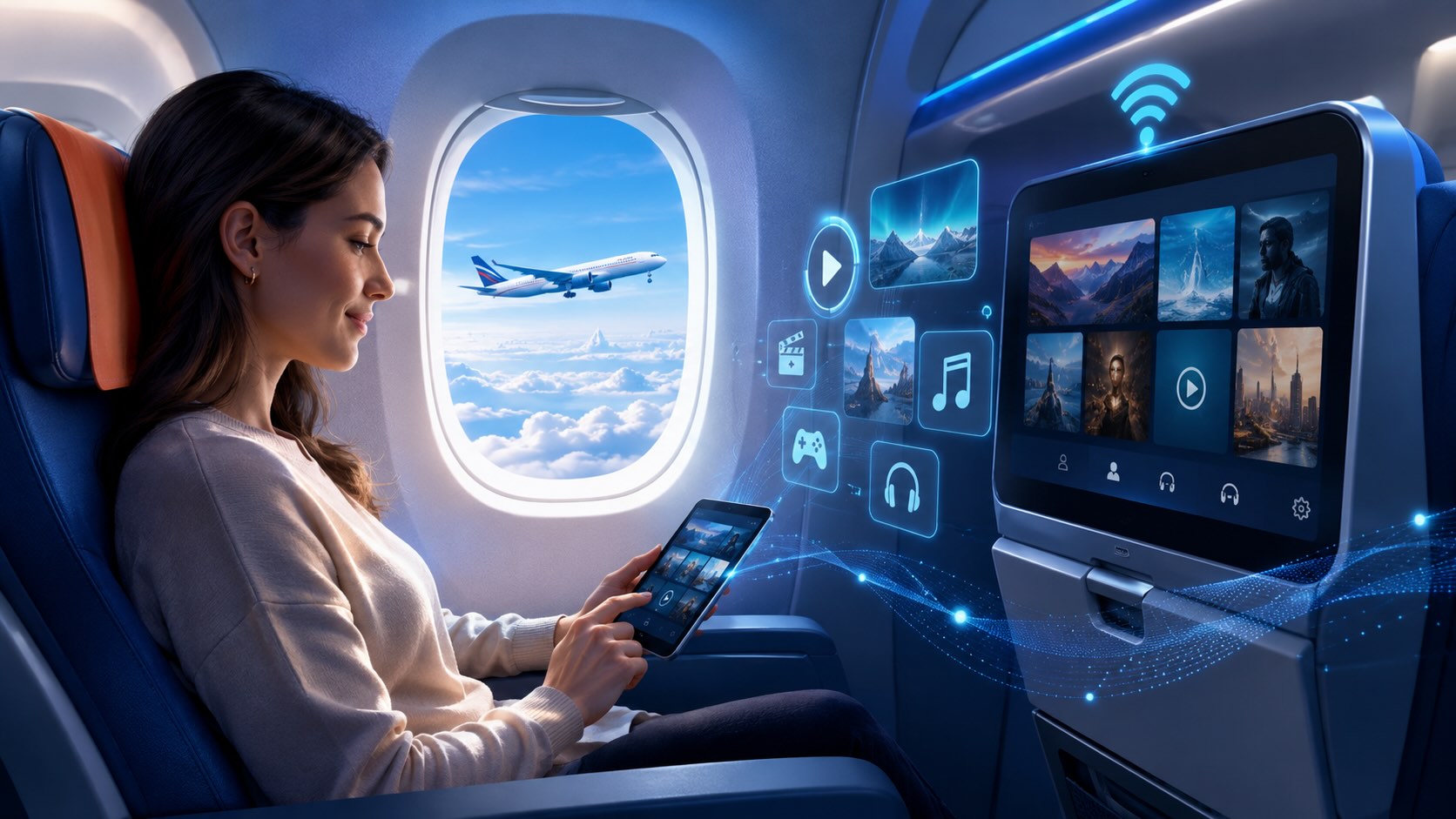
The main trend is the shift toward wireless solutions (BYOD), where passengers use their own smartphones, tablets, or laptops. Instead of expensive built-in screens, airlines get a local Wi-Fi platform that is much easier to implement, requires lower maintenance costs, and is suitable for virtually any type of aircraft. For Russian carriers with a mixed fleet of Airbus, Boeing, Superjet, and the promising MC-21, this format has proven to be the most effective.
Against the backdrop of these changes, Russian developers are beginning to play a special role, as they are able to offer not just a standalone media server, but a comprehensive digital ecosystem. One of the most actively developing players is Oblako LLC, with its “Etbox” hardware-software complex. The company has created its own Wi-Fly platform, which combines in-flight entertainment, digital services for passengers, and monetization tools for airlines.
Today, the Wi-Fly platform is already in use on more than 55 aircraft, and the number of passengers who have used the service has exceeded 8.5 million. At the same time, the system is constantly evolving and goes far beyond the scope of traditional IFE. In addition to movies, TV shows, music, books, and children’s content, passengers gain access to an interactive flight map, flight information, and additional carrier services, while the airline benefits from a modern digital platform for interacting with customers.
One of the platform’s key advantages is its modular architecture. The carrier can implement either a basic multimedia portal or gradually add additional services: meal ordering, merchandise sales, travel offers, advertising integrations, loyalty programs, and other digital products. This approach not only improves the quality of passenger service but also creates new sources of additional revenue.
Another key advantage is that the platform is developed entirely in Russia. Given limited access to foreign technologies, airlines need solutions that can be quickly maintained, updated, and adapted to their own requirements without relying on foreign suppliers. This factor is now one of the main considerations when selecting a new platform.
Wi-Fly’s development clearly reflects the overall transformation of the market. While just a few years ago the main criterion was the ability to provide passengers with access to movies during the flight, today airlines require a full-fledged digital ecosystem. This is precisely why modern platforms are increasingly becoming part of carriers’ digitalization strategies.
At the same time, the market remains competitive. Some domestic companies are also developing their own in-flight entertainment solutions; however, most of them focus primarily on individual elements of the ecosystem or implement projects tailored to specific carriers. As a result, a comprehensive approach is becoming the key factor in competitiveness.
New Russian aircraft are expected to provide an additional boost to market development. As deliveries of the MS-21, SJ-100, and other domestic aircraft increase, digital platforms will be able to be installed during the aircraft’s manufacturing phase, rather than only during the modernization of the existing fleet. This opens up a fundamentally new market for Russian developers.
Another driver will be rising passenger expectations. Today, travelers view digital services as an essential part of a comfortable flight. The ability to watch content, receive flight information, use additional services, and interact with the airline through a single interface is gradually becoming the norm even on medium-haul flights.
Therefore, in 2026–2028, the IFE market will grow not so much through the installation of new in-flight screens as through the development of intelligent digital platforms.
The main demand will be focused on domestic solutions that ensure independence from foreign technologies, rapid deployment, flexible integration with airline services, and the potential for further scalability.
It is precisely this segment that currently shows the greatest potential. The Russian market is gradually transitioning from import substitution to a stage of technological development, where companies capable of offering carriers not just an in-flight entertainment system but a full-fledged digital ecosystem for passengers gain a competitive advantage. Wi-Fly is already operating under this model, which allows the company to hold a strong position in this emerging market and participate in its further development.