
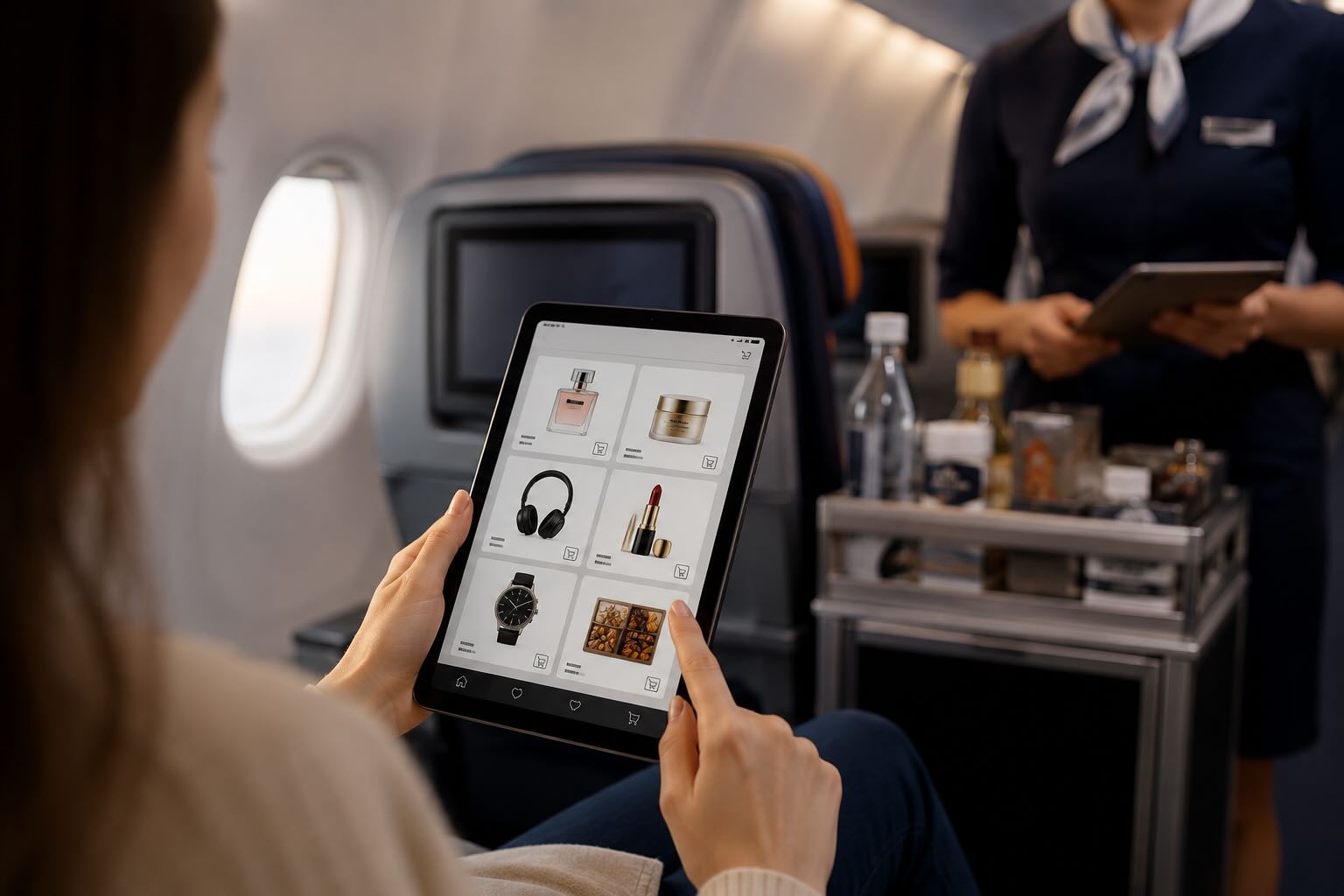
For a long time, in-flight sales followed a familiar pattern: a passenger would open a paper catalog, flip through the pages featuring perfumes, cosmetics, sweets, toys, or souvenirs, select an item, and wait for a flight attendant to take the order. This method was straightforward, but not the most convenient. The catalog quickly became outdated; some items might run out before the flight was even halfway through, and the crew had to spend time checking availability, calculating totals, and providing explanations. Today, this model is gradually being replaced by a digital showcase.
A digital in-flight catalog isn’t just the same brochure transferred to a screen. It’s a dynamic system that shows passengers the items available specifically on that flight. Instead of a pretty picture from a general list, passengers see more precise information: what’s on board, which items are running low, which can be ordered immediately, and which are available only on certain routes. This reduces disappointment when a selected item turns out to be unavailable and speeds up the purchasing process.
Everything becomes easier for the passenger. There’s no need to wait for a paper catalog, search for the right page, or ask a flight attendant if an item is still in stock. All they have to do is open the in-flight shop on their personal device or the seat-back screen, select the item they want, and place an order. The cabin crew receives the order and delivers the purchase at a convenient time during service. As a result, there’s less commotion in the aisle, fewer unnecessary questions, and fewer mistakes.
The main advantage of the digital catalog is up-to-date inventory levels. In the paper version, the same list of items could be used for a long time, even though the actual inventory on the flight changed every day. On some routes, perfume and cosmetics sold well, while on others, snacks, beverages, children’s kits, or merchandise featuring city symbols were popular. The paper catalog couldn’t account for these differences. The digital showcase allows airlines to display only what’s actually on board and update the product selection more quickly.
This is especially important for airlines. Space on the plane is limited; every extra item takes up weight and volume. If too many unpopular items are loaded, they’ll just bounce around. If too few in-demand items are carried, the company will lose sales. Digital data helps identify what passengers buy most often, at what point during the flight they place orders, which items they browse but don’t buy, and where demand is highest. Based on this information, inventory can be planned more accurately.
A digital catalog also helps test new products more quickly. Previously, to update a paper catalog, it was necessary to prepare a layout, print a run, deliver it to the aircraft, and wait for sales results. This took time and money. Now, a new product can be added to the display much faster, and then the airline can see how passengers react to it. If an item doesn’t generate interest, it can be replaced. If demand is high, it can be stocked more frequently on the relevant flights.
Another important change concerns the crew’s work. Paper-based sales require a lot of manual steps: taking an order, checking availability, locating the item, processing payment, and remembering who to bring what to. When orders are received digitally, the process becomes more streamlined. Flight attendants see a list of orders, can serve passengers more quickly, and are less distracted by follow-up questions. This doesn’t eliminate face-to-face interaction, but it does remove some of the unnecessary workload.
For passengers, a digital storefront can be more engaging than a traditional catalog. It’s easier to display photos, descriptions, set contents, prices, and purchase terms. You can highlight items suitable as gifts, offer limited-time promotions on specific flights, or remind passengers about products before boarding. At the same time, it’s important not to overwhelm passengers with advertising. On an airplane, passengers are in a confined space, so intrusive offers can be annoying. A good digital showcase should be helpful, not overwhelming.
There’s another advantage: less paper. For an airline, this isn’t just a matter of environmental responsibility—it’s also a practical benefit. Paper catalogs need to be printed, stored, distributed, and replaced when prices or the product range are updated. They wear out, get dirty, and get lost. A digital catalog is easier to update and keep in order. It doesn’t take up space in the seat pocket and doesn’t need to be constantly replaced.
Of course, the transition to digital in-flight sales requires preparation. You need to ensure convenient access to the catalog, a clear ordering process, secure payment, and communication between the passenger’s device and the crew. It’s important to consider what to do if a passenger doesn’t want to use their phone or if their device runs out of battery. That’s why the digital format doesn’t always completely replace traditional sales methods right away. In the early stages, it often operates alongside traditional service.
But the overall direction is already clear. In-flight sales are becoming more accurate, faster, and more manageable. Passengers are presented with a clear selection and are less likely to encounter the “we’re out of that” situation. The crew works more calmly. The airline gains a better understanding of demand and can go beyond simply selling products to tailoring its product range to passengers’ actual habits.
The digital catalog is changing the very logic of in-flight sales. Previously, it was a static list of products that was the same for many flights. Now it’s a flexible showcase that can take into account the destination, inventory levels, flight duration, and passenger interests. For the in-flight retail market, this is a significant step forward: less randomness, more convenience, and more data for making the right decisions.