
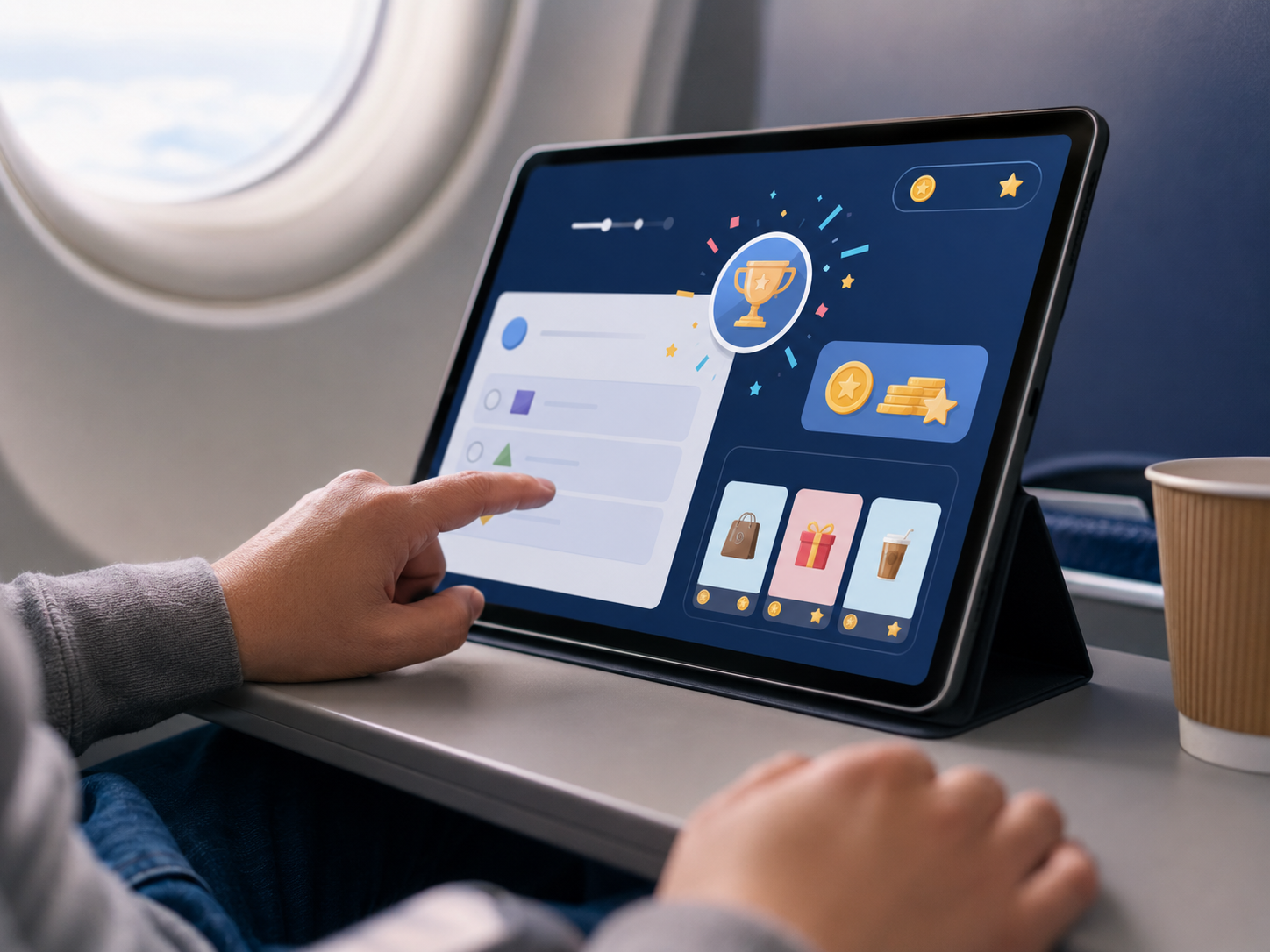
Not long ago, the in-flight portal was primarily associated with movies, music, and flight information. Now, its capabilities are gradually expanding beyond entertainment. For airlines, the portal can become another touchpoint with passengers – offering a loyalty program, personalized offers, and mechanics that continue to work even after landing.
The main advantage of this approach is that interaction occurs when the passenger is already within the carrier's customer ecosystem. They don't need to install a separate app or search for a loyalty program website: the necessary functions are available directly on board.
Bonuses for In-Flight Activity
One of the most straightforward scenarios is awarding bonuses for participating in interactive activities. For example, passengers might be offered a quiz about cities in the route network, aviation, or travel.
For correct answers, completing a certain number of stages, or participating in a special promotion, passengers can earn miles, loyalty program points, or virtual rewards.
For the passenger, this is an additional element of in-flight entertainment. For the airline, it's a way to increase engagement and introduce customers to the capabilities of their loyalty program without direct advertising.
The mechanics can also be more complex. For instance, high-tier program members receive an increased number of points, while new users are offered to register for the program after the quiz and keep the earned bonus.
Partner Offers Right On Board
Another scenario involves airline partners. The in-flight portal can feature special offers from hotels, car rental services, restaurants, travel platforms, banks, or entertainment companies.
Unlike a regular advertising banner, such an offer can be linked to the context of a specific trip. On a flight to Istanbul, a passenger might be offered a discount on airport transfer; on a route to Sochi, a special hotel rate; and before arriving in a major European city, a bonus for booking an excursion.
In this case, the portal becomes not just an advertising platform, but a part of the journey. The offer appears when it is potentially most relevant to the passenger.
A Promo Code That Keeps Working After Landing
Promo codes allow connecting the in-flight and ground experience. Passengers can receive a unique code for participating in an activity, viewing a special section, or fulfilling promotion conditions.
It can be used after the flight – on the airline's website, in the mobile app, or with a partner.
This allows transforming a few minutes of interaction with the in-flight portal into a subsequent targeted action: purchasing an additional service, booking the next ticket, arranging insurance, or ordering a partner service.
Moreover, promo codes give airlines another important advantage – measurability. The carrier can assess how many passengers saw the offer, how many received the code, and what proportion ultimately used it.
Loyalty Becomes Part of the Journey Itself
For airlines, this approach changes the role of the in-flight portal. From a separate entertainment service, it transforms into a digital channel connected to sales, marketing, and the loyalty program.
However, the task is not just to show the passenger more advertisements. An effective scenario should provide clear value: entertain, offer a bonus, provide a useful discount, or unlock a personalized opportunity.
As a result, the loyalty program ceases to exist only between flights. It becomes part of the flight itself – and a few hours on board turn into another opportunity to continue the relationship between the passenger and the airline.