
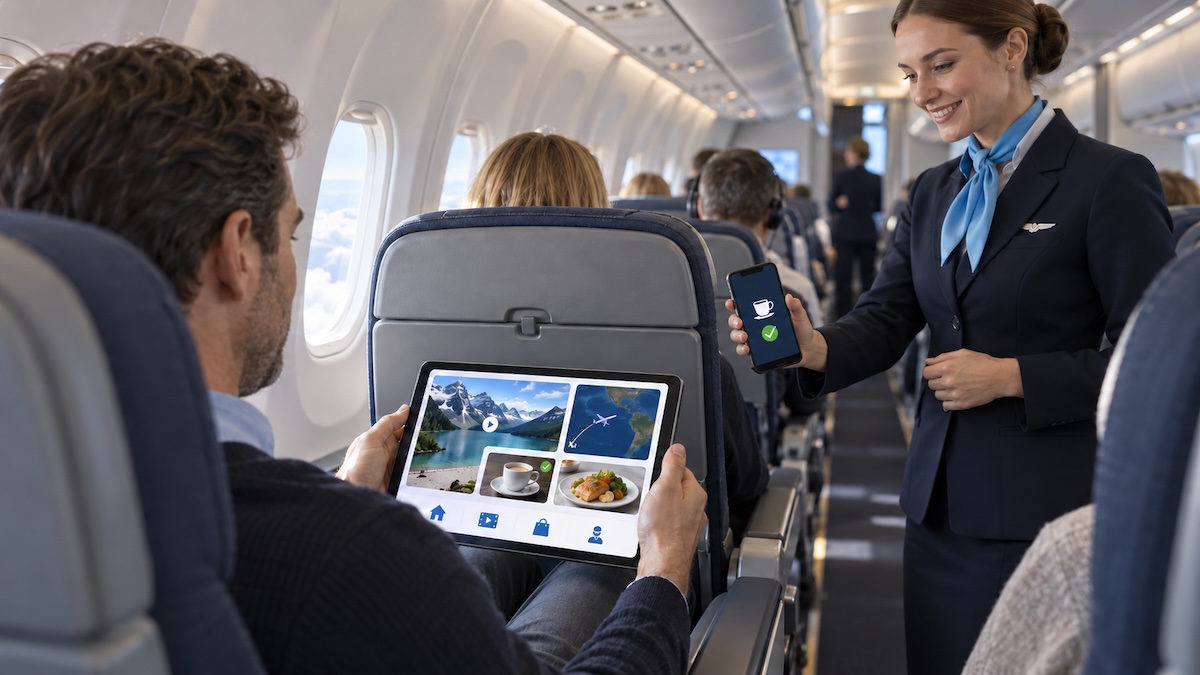
Choosing a movie, ordering a drink, viewing the route, and finding an interesting excursion after arrival — the in-flight portal is becoming a gateway to various travel opportunities. For passengers, these should coalesce into a clear, user-friendly service accessible from a smartphone or tablet. Therefore, the further development of such systems is not only about adding functions but also about how cohesively they operate.
Wi-Fly, developed by Oblako company, already integrates multimedia content, flight information, commerce, and advertising formats. This foundation allows the portal to evolve in several directions: simplifying entertainment choices, making offers more useful, linking passenger actions with crew operations, and evaluating the quality of the digital service.
Autonomy will remain a key principle. Wi-Fly content is stored on an onboard server and transmitted to passenger devices via a local Wi-Fi network. A constant internet connection is not required for watching downloaded movies, listening to music, and accessing the media library. External communication is used for content updates and data synchronization.
The development of onboard internet can complement this model. The local media library will provide access to pre-prepared content, while an external connection will allow for additional online services. For the passenger, this distinction should be practically seamless: a movie from the onboard server continues to play regardless of the external connection status, and the availability of other functions is clear from the interface.
The next direction is personalization. A large catalog is only useful when it's easy to find suitable material. A promising scenario for Wi-Fly is curated selections based on the chosen language, passenger interests, and flight duration. Before landing, a short episode could be offered; for a family trip, children's content; and before arrival, materials about the destination city.
Such personalization can start with simple settings: favorite genre, language, or available viewing time. Its goal is to reduce search time and help the passenger make a choice. More complex scenarios will require additional integrations and clear terms of use for personal data.
Advertising opportunities will also evolve around the context of the journey. Wi-Fly offers banners, video ads, branded games, quizzes, and special projects. Route-based targeting allows offers to be linked to the travel destination. Further development of this approach involves a sequential introduction to a brand: from interesting content or a game task to an offer page and a promo code that will be useful after arrival.
For advertisers, this is an opportunity to build meaningful contact with the passenger. For the traveler themselves, it's a chance to get a useful idea: where to go, what to try, or which excursion to choose. The quality of such interaction depends on the relevance of the offer and how organically it is integrated into the portal.
Onboard retail will be more closely linked to cabin service. Digital menus and catalogs allow passengers to browse the assortment on their devices. The next step is to link product selection with actual availability, order processing, and a clear fulfillment status. After ordering a drink, a person should understand whether the request has been accepted and what will happen next.
Crew applications take on special significance here. A promising scenario is a working interface where flight attendants see orders by seat, passenger requests, and remaining inventory. Such a tool must account for the pace of service: helping to prioritize, quickly find the right order, and mark its completion. The development of the passenger portal in this case is directly related to the convenience of staff work.
Analytics helps to unify these processes. Wi-Fly provides statistics on content usage and interaction with advertising materials. This allows for evaluating interest in sections, views, and offers. As services evolve, it will become increasingly important to understand the entire passenger journey: whether they were able to connect, find the necessary material, and complete the chosen action.
Such data is useful not only for assessing popularity. If a section is frequently opened but quickly abandoned, navigation and content should be checked. If a product generates interest but an order isn't placed, the purchase conditions and interface usability should be investigated. Analytics becomes the basis for specific changes in the portal.
For Oblako company, the development of the Russian solution is linked to the practical tasks of carriers: adapting the service to fleet specifics, updating content, and combining functions in a convenient digital environment. The specific set of capabilities depends on the aircraft's equipment, available connectivity, and service organization, so implementing new scenarios requires coordinated work between the developer and the airline.
The in-flight portal of the coming years will be evaluated by simple results: how easy it is to connect, quickly choose entertainment, receive a service, and prepare for arrival. It is around these actions that the further development of Wi-Fly unfolds — as a service for passengers, a working tool for carriers, and a platform for interaction with brands.